Abstract
Digestive disorders including dyspepsia, hyperacidity, and functional bowel complaints are among the most frequently presenting complaints in Unani (Tibb) clinical practice, where single herbal drugs (mufradat) such as Zeera Siyah, Podina, and Anjeer are widely prescribed based on classical texts. However, variability in raw material sourcing, harvesting season, and processing methods presents ongoing challenges for consistent therapeutic quality and regulatory acceptance. This study undertakes pharmacognostic characterization and phytochemical profiling of commonly used Unani single drugs indicated for digestive disorders, establishing macroscopic, microscopic, and physicochemical standardization parameters alongside preliminary phytoconstituent screening. Results are discussed in relation to existing Ayurvedic Pharmacopoeia and Unani Pharmacopoeia of India standards, with recommendations for strengthening quality-control protocols to support safe, reproducible, and pharmacopoeially compliant use of these traditional digestive remedies in contemporary integrative practice.
- Unani Medicine
- Pharmacognosy
- Phytochemical Standardization
- Mufradat
- Digestive Disorders
- Unani Pharmacopoeia
- Quality Control
- Traditional Drugs
Introduction#
The family is the first and most influential social institution in a child's life, serving as the foundation for emotional, behavioural, cognitive, and social development. Parents play a vital role in nurturing children's personalities, values, emotional well-being, and academic aspirations through their daily interactions, communication, guidance, and discipline. These consistent patterns of child-rearing are known as **parenting styles**, which significantly influence children's overall growth and future success. The four major parenting styles—authoritative, authoritarian, permissive, and uninvolved—have been widely recognized in developmental psychology. Among these, authoritative parenting, characterized by warmth, responsiveness, and appropriate discipline, is generally associated with higher self-esteem, emotional stability, positive social behaviour, and better academic achievement. In contrast, authoritarian parenting emphasizes strict discipline and obedience with limited emotional support, often leading to lower self-confidence and emotional distress. Permissive parenting offers affection but lacks consistent rules and boundaries, which may contribute to impulsive behaviour and poor self-regulation, whereas uninvolved parenting is marked by minimal supervision and emotional neglect, resulting in negative developmental outcomes.
Parenting styles significantly influence three essential dimensions of child and adolescent development: emotional development, behavioural adjustment, and academic achievement.
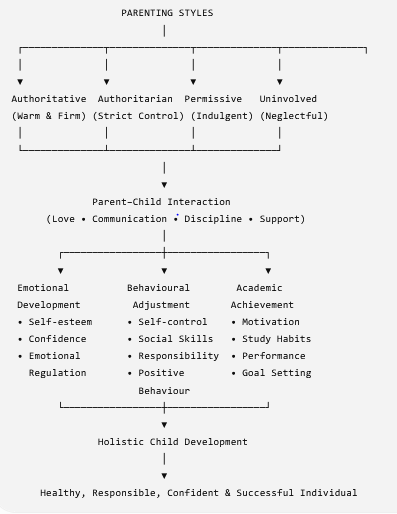
Figure: Conceptual Background
Supportive parenting promotes emotional security, resilience, empathy, confidence, and healthy emotional regulation, while harsh or neglectful parenting may contribute to anxiety, aggression, depression, and low self-esteem. Similarly, consistent discipline, effective communication, and parental involvement foster responsible behaviour, self-control, and positive social relationships, whereas inconsistent or punitive parenting may lead to behavioural problems and poor social adjustment. Parents also contribute substantially to children's academic success by creating supportive learning environments, monitoring educational progress, encouraging positive study habits, and maintaining communication with schools. In the modern era, rapid technological advancement, changing family structures, increasing academic competition, and excessive digital media exposure have introduced new challenges to parenting. Therefore, understanding the influence of parenting styles has become increasingly important for promoting children's holistic development and designing effective educational, psychological, and family support interventions.
Influence of Parenting Styles on Emotional Development among Children and Adolescents#
Emotional development is a fundamental aspect of child and adolescent growth, as it influences an individual's ability to recognize, understand, express, and regulate emotions while building healthy relationships and adapting to various life situations. Parenting styles play a decisive role in shaping children's emotional well-being because parents are the primary source of love, security, guidance, and emotional support during the early years of life. The quality of parent–child interactions significantly affects children's emotional intelligence, self-esteem, resilience, empathy, stress management, and psychological adjustment. Among the four major parenting styles, authoritative parenting is consistently regarded as the most beneficial for emotional development because it combines warmth, responsiveness, open communication, and appropriate discipline. Children raised by authoritative parents generally develop higher self-confidence, emotional stability, optimism, empathy, and the ability to cope effectively with challenges. These parents encourage children to express their feelings freely, discuss problems openly, and participate in family decision-making while maintaining reasonable expectations and behavioural boundaries. Such supportive interactions foster emotional security, strengthen parent–child attachment, and promote healthy emotional regulation. In contrast, authoritarian parenting emphasizes strict discipline, unquestioning obedience, and high parental control with relatively limited emotional warmth. Although children raised in authoritarian families may display discipline and respect for authority, they often experience fear, anxiety, low self-esteem, emotional suppression, and difficulty expressing their thoughts and feelings. Excessive criticism and harsh punishment may discourage independent thinking and reduce children's confidence in handling emotional challenges. Similarly, permissive parenting is characterized by high parental warmth but minimal discipline and few behavioural expectations. While children in permissive households often feel emotionally accepted, the absence of consistent rules and guidance may limit the development of self-control, emotional regulation, frustration tolerance, and responsibility. Such children may struggle to manage negative emotions, cope with failure, and develop resilience during stressful situations. Uninvolved parenting represents the least supportive parenting style because parents provide minimal emotional involvement, supervision, or guidance. Children raised in such environments frequently experience emotional neglect, loneliness, insecurity, poor self-worth, and increased vulnerability to anxiety, depression, and other psychological difficulties due to the absence of consistent parental support and affection. Emotional development is also influenced by several parenting behaviours beyond general parenting style, including effective communication, emotional responsiveness, positive reinforcement, encouragement, empathy, and parental availability. Parents who actively listen to their children's concerns, validate their emotions, and provide constructive guidance help children develop emotional intelligence and positive coping strategies. Conversely, inconsistent parenting, family conflict, domestic violence, excessive criticism, unrealistic expectations, and emotional neglect can negatively affect children's mental health and emotional adjustment. During adolescence, emotional development becomes particularly important because young people experience rapid physical, cognitive, and social changes alongside increased academic demands and peer influences. Supportive parenting during this period helps adolescents develop emotional resilience, maintain psychological well-being, and make responsible decisions while coping with stress, peer pressure, and identity formation. The modern era has introduced additional challenges that influence emotional development. Rapid technological advancement, increased use of smartphones, social media, online learning, and digital communication have transformed children's social experiences and family interactions. Although digital technologies provide educational opportunities and social connectivity, excessive screen time, cyberbullying, social comparison, internet addiction, and reduced face-to-face family communication may negatively affect children's emotional health. Consequently, modern parents must balance technological freedom with appropriate supervision while maintaining meaningful emotional connections with their children. Family structure, socioeconomic status, parental education, and cultural values also contribute to emotional development by influencing parenting practices and the home environment. Families characterized by warmth, mutual respect, and supportive communication generally create emotionally secure environments that encourage healthy personality development. Schools, teachers, counsellors, and mental health professionals further complement parental efforts by providing emotional guidance, counselling services, and social-emotional learning programmes that strengthen children's coping skills and psychological resilience. Numerous psychological and educational studies consistently demonstrate that children who experience nurturing, responsive, and emotionally supportive parenting exhibit greater happiness, emotional maturity, life satisfaction, and interpersonal competence than those exposed to neglectful or excessively controlling parenting practices. These emotionally healthy children are more likely to establish positive peer relationships, demonstrate empathy, resolve conflicts peacefully, and adapt successfully to changing social environments. Therefore, strengthening positive parenting practices through parental education, family counselling, community awareness programmes, and school–parent partnerships is essential for promoting healthy emotional development among children and adolescents. In the rapidly evolving modern world, where children face increasing academic competition, technological distractions, and psychological pressures, emotionally supportive parenting remains one of the most effective protective factors for ensuring mental well-being, emotional resilience, and overall personality development. Ultimately, parenting styles shape children's emotional foundations, influencing not only their present psychological adjustment but also their future relationships, career success, and quality of life.
Impact of Parenting Styles on Behavioural Adjustment among Children and Adolescents#
Behavioural adjustment refers to the ability of children and adolescents to regulate their actions, adapt to family, school, and social environments, and demonstrate socially acceptable behaviour while maintaining healthy interpersonal relationships and emotional stability. It reflects an individual's capacity to manage emotions, solve problems, follow social norms, cooperate with others, and respond positively to everyday challenges. Parenting styles are among the most influential factors affecting behavioural adjustment because parents establish the first environment in which children learn discipline, responsibility, communication, empathy, and moral values. Through consistent guidance, supervision, and emotional support, parents help children develop appropriate behavioural patterns that contribute to positive social functioning and personal growth. Among the four parenting styles, authoritative parenting has consistently been associated with the most favourable behavioural outcomes. Authoritative parents maintain a balance between affection and discipline by setting clear expectations while encouraging open communication and mutual respect. Children raised in such environments generally exhibit greater self-control, responsibility, cooperation, empathy, honesty, and problem-solving abilities. They are more likely to respect rules, manage conflicts peacefully, demonstrate prosocial behaviour, and adapt successfully to school and community settings. Because authoritative parents encourage independence while providing appropriate supervision, children develop confidence in making responsible decisions and become less vulnerable to behavioural problems. In contrast, authoritarian parenting relies heavily on strict discipline, rigid rules, and obedience, often with limited emotional warmth. Although children raised under authoritarian parenting may initially display disciplined behaviour, excessive control and harsh punishment can contribute to fear, aggression, low self-confidence, poor communication skills, and rebellious behaviour during adolescence. These children may comply with rules in the presence of authority figures but struggle with independent decision-making and emotional regulation. Permissive parenting, characterized by warmth but limited discipline, also presents behavioural challenges. Parents who rarely enforce rules or consequences may unintentionally encourage impulsive behaviour, poor self-discipline, irresponsibility, and difficulty respecting authority. Children raised in permissive households may experience problems managing frustration, delaying gratification, and accepting constructive criticism, leading to behavioural difficulties in educational and social environments. Uninvolved parenting has the most detrimental impact on behavioural adjustment because limited parental supervision, emotional neglect, and weak communication often result in poor self-regulation, social withdrawal, aggression, substance abuse, delinquency, and other high-risk behaviours. Children who lack parental guidance frequently seek acceptance from peers, making them more susceptible to negative social influences and antisocial activities. Behavioural adjustment is influenced not only by parenting style but also by the quality of parent–child relationships, consistency of discipline, parental monitoring, communication, and family environment. Parents who establish clear behavioural expectations, provide positive reinforcement, encourage responsibility, and resolve conflicts through constructive discussion help children internalize moral values and develop socially appropriate behaviour. Positive parenting also teaches empathy, cooperation, patience, honesty, and respect for others, which are essential for successful interpersonal relationships. Conversely, inconsistent discipline, family conflict, domestic violence, parental substance abuse, and neglect create stressful environments that increase the likelihood of behavioural disorders, emotional instability, and social maladjustment. During adolescence, behavioural adjustment becomes increasingly important as young people experience greater independence, peer influence, identity exploration, and academic pressure. Effective parenting during this developmental stage requires balancing supervision with autonomy, enabling adolescents to make responsible decisions while receiving emotional guidance and parental support. The modern era presents additional challenges to behavioural adjustment due to rapid technological advancements, increased social media use, online gaming, cyberbullying, digital addiction, and changing family structures. Excessive screen time and reduced face-to-face interaction may contribute to social isolation, impulsive behaviour, reduced empathy, and poor interpersonal communication if not managed appropriately. Parents who actively monitor digital activities, establish healthy technology-use guidelines, and encourage participation in sports, cultural activities, community service, and family interactions help children develop balanced behavioural patterns. Schools also play an essential role by reinforcing discipline, teamwork, leadership, and ethical values through classroom learning, extracurricular activities, counselling services, and behavioural intervention programmes. Collaboration between parents, teachers, school counsellors, and mental health professionals creates a supportive environment that strengthens children's behavioural adjustment and social competence. Numerous empirical studies have consistently demonstrated that children raised in supportive, nurturing, and well-structured family environments exhibit fewer behavioural problems and greater psychological adjustment than those exposed to harsh, inconsistent, or neglectful parenting. Positive parenting promotes resilience, emotional stability, responsible citizenship, and constructive social participation, whereas ineffective parenting increases the risk of aggression, bullying, academic misconduct, substance abuse, and juvenile delinquency. Therefore, strengthening parenting education, promoting positive discipline, enhancing parent–child communication, and encouraging family involvement in children's daily lives are essential strategies for improving behavioural adjustment among children and adolescents. In an increasingly complex and technology-driven society, effective parenting remains one of the strongest protective factors against behavioural problems and contributes significantly to the development of socially responsible, emotionally balanced, and ethically responsible individuals capable of leading productive and successful lives.
Conclusion#
Parenting styles continue to be one of the most influential factors shaping the emotional, behavioural, and academic development of children and adolescents in the modern era. The present study highlights that the family serves as the primary environment where children develop emotional security, moral values, social competence, and learning habits that influence their overall personality and future success. The findings indicate that parenting styles significantly affect children's emotional regulation, self-esteem, behavioural adjustment, interpersonal relationships, and educational achievement. Among the four parenting styles, authoritative parenting consistently demonstrates the most positive developmental outcomes because it combines warmth, emotional support, effective communication, reasonable expectations, and consistent discipline. Children raised in authoritative families are generally more confident, emotionally resilient, socially responsible, academically motivated, and capable of making independent decisions. In contrast, authoritarian parenting, although promoting discipline and obedience, may limit emotional expression, reduce self-confidence, and increase anxiety due to excessive control and harsh disciplinary practices. Similarly, permissive parenting, despite providing affection and acceptance, often lacks sufficient guidance and behavioural boundaries, resulting in reduced self-discipline and inconsistent academic performance. Uninvolved parenting remains the least effective approach because emotional neglect, limited supervision, and weak parent–child relationships frequently contribute to emotional distress, behavioural problems, poor academic achievement, and reduced social competence. The study further emphasizes that emotional development forms the foundation for healthy personality growth, behavioural adjustment supports successful adaptation to family and society, and academic achievement reflects the combined influence of cognitive ability, motivation, and parental support. These three developmental dimensions are closely interconnected and collectively determine children's overall well-being and future opportunities. In today's rapidly changing world, parents face new challenges arising from digital technology, social media, online learning, changing family structures, increasing academic competition, and work-life imbalance. While technological advancements provide valuable educational opportunities, they also require parents to establish healthy digital habits, monitor online activities, and maintain meaningful family communication. Modern parenting therefore demands flexibility, emotional intelligence, effective communication, and balanced discipline that encourages independence while providing adequate supervision and guidance. Schools, teachers, psychologists, counsellors, and community organizations also play complementary roles by collaborating with parents to create supportive environments that promote children's emotional health, positive behaviour, and educational success. Parent education programmes, family counselling services, school–parent partnerships, and mental health awareness initiatives can further strengthen parenting practices and improve developmental outcomes. Policymakers should continue promoting family-friendly policies, parenting education, child mental health services, and educational support systems that assist parents in meeting the complex demands of raising children in contemporary society. Ultimately, successful parenting extends beyond providing material needs; it involves nurturing emotionally secure, socially responsible, academically competent, and ethically responsible individuals capable of adapting to changing societal conditions. By fostering positive parent–child relationships, encouraging open communication, providing consistent guidance, and supporting children's emotional and educational needs, families can significantly contribute to the holistic development of future generations. Therefore, strengthening positive parenting practices remains an essential strategy for promoting children's overall well-being and preparing them to become confident, resilient, productive, and responsible citizens in the modern world.
Works Cited#
- Darling, N., & Steinberg, L. (1993). Parenting style as context: An integrative model. Psychological Bulletin, 113(3), 487–496.
- Diana Baumrind. (2013). Authoritative parenting revisited: History and current perspectives. In R. E. Larzelere et al. (Eds.), Authoritative Parenting: Synthesizing Nurturance and Discipline for Optimal Child Development. American Psychological Association.
- Eccles, J. S., & Roeser, R. W. (2011). Schools as developmental contexts during adolescence. Journal of Research on Adolescence, 21(1), 225–241.
- Ginsburg, K. R. (2007). The importance of play in promoting healthy child development and maintaining strong parent-child bonds. Pediatrics, 119(1), 182–191.
- Maccoby, E. E., & Martin, J. A. (1983). Socialization in the context of the family: Parent-child interaction. In P. H. Mussen (Ed.), Handbook of Child Psychology (Vol. 4). Wiley.
- Masud, H., Thurasamy, R., & Ahmad, M. S. (2015). Parenting styles and academic achievement of young adolescents: A systematic literature review. Quality & Quantity, 49(6), 2411–2433.
- Pinquart, M. (2016). Associations of parenting styles and dimensions with academic achievement in children and adolescents: A meta-analysis. Educational Psychology Review, 28(3), 475–493.
- Santrock, J. W. (2023). Life-Span Development (19th ed.). McGraw-Hill Education.
- Spera, C. (2005). A review of the relationship among parenting practices, parenting styles, and adolescent school achievement. Educational Psychology Review, 17(2), 125–146.
- World Health Organization. (2021). Guidelines on Physical Activity, Sedentary Behaviour and Sleep for Children and Adolescents. WHO.
- Yaffe, Y. (2020). Parenting styles and academic achievement among adolescents: The mediating role of self-efficacy. International Journal of Educational Methodology, 6(2), 307–316.
- Zins, J. E., Weissberg, R. P., Wang, M. C., & Walberg, H. J. (Eds.). (2004). Building Academic Success on Social and Emotional Learning. Teachers College Press.