Abstract
Chronic inflammatory disorders such as osteoarthritis, rheumatoid conditions, and inflammatory bowel disturbances remain a significant burden on global healthcare systems, with conventional allopathic anti-inflammatory therapy often limited by adverse gastrointestinal, renal, and cardiovascular effects on long-term use. Traditional systems of medicine, particularly Ayurveda and Unani (Tibb), have historically employed herbal and herbo-mineral formulations — including guggulu-based compounds, Rasna Saptak Kwath, and Unani muhallil (resolvent) preparations — for the management of inflammatory conditions, with mechanisms increasingly explored through modern pharmacological and phytochemical analysis. This study undertakes a comparative evaluation of classical Ayurvedic and Unani anti-inflammatory formulations, examining their reported clinical efficacy, safety profiles, and proposed mechanisms of action alongside standard allopathic NSAID therapy. Secondary objectives include reviewing standardization and quality-control practices for herbal formulations, and identifying opportunities for integrative treatment protocols that combine traditional and allopathic approaches under evidence-based clinical supervision. Findings are intended to support pharmacovigilance, standardization initiatives, and future controlled-trial design in integrative inflammatory-disease management.
- Ayurveda
- Unani
- Chronic Inflammation
- Herbal Formulations
- Guggulu
- Integrative Medicine
- Pharmacovigilance
- Anti-Inflammatory Therapy
- Traditional Medicine
- Allopathic Comparison
Introduction#
Commercial transactions form the foundation of modern economic development by facilitating trade, investment, entrepreneurship, technological innovation, and international business cooperation. As commercial activities have expanded across national borders through globalization, digital markets, multinational corporations, and complex contractual arrangements, disputes arising from business transactions have become increasingly frequent and sophisticated. These disputes may involve contractual breaches, shareholder disagreements, intellectual property rights, construction projects, banking and finance, insurance claims, mergers and acquisitions, international trade, e-commerce, and infrastructure development. Traditionally, such disputes have been resolved through litigation before courts of law. However, judicial proceedings are often associated with procedural delays, high litigation costs, heavy case backlogs, and adversarial processes that may permanently damage commercial relationships. Consequently, businesses increasingly prefer Alternative Dispute Resolution (ADR) mechanisms that offer faster, more flexible, confidential, and commercially practical solutions.
Alternative Dispute Resolution refers to a range of processes that resolve disputes outside traditional courtroom litigation. These include negotiation, mediation, conciliation, arbitration, and expert determination, each providing varying degrees of party autonomy, procedural flexibility, and legal enforceability. Among these mechanisms, mediation has emerged as one of the most preferred methods for resolving commercial disputes because it emphasizes dialogue, cooperation, and mutually acceptable outcomes rather than adversarial confrontation. In mediation, an impartial third party assists disputing parties in identifying common interests, improving communication, and negotiating voluntary settlement agreements without imposing a binding decision. This collaborative approach helps preserve long-term commercial relationships, protect business reputation, reduce legal expenses, and minimize operational disruptions.
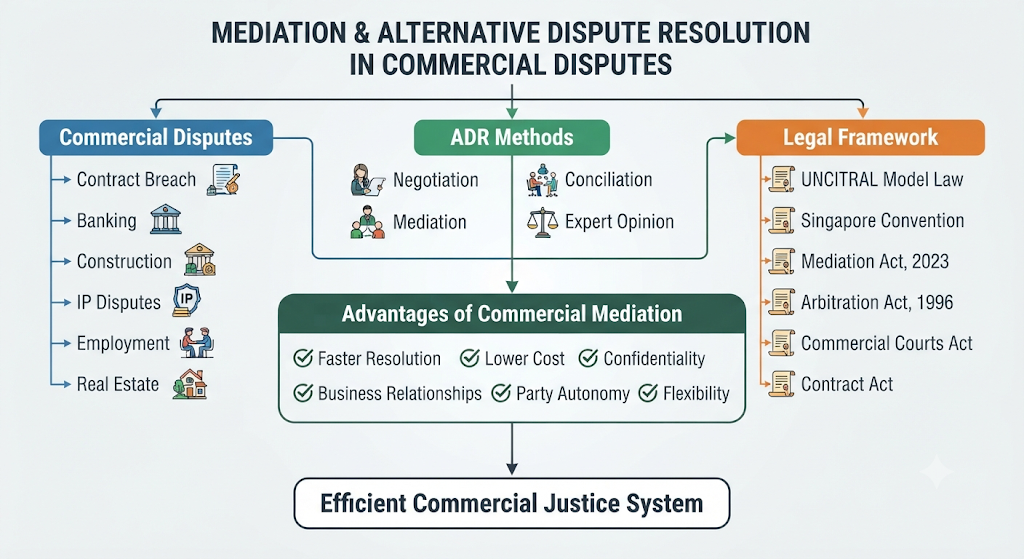
Figure: Conceptual Background
The international legal framework governing commercial mediation has developed significantly over recent decades. The United Nations Commission on International Trade Law (UNCITRAL) has played a central role by adopting the Model Law on International Commercial Mediation and facilitating harmonization of mediation laws across jurisdictions. A landmark development was the adoption of the Singapore Convention on Mediation (2019), which establishes an international framework for the recognition and enforcement of cross-border mediated settlement agreements, comparable to the role of the New York Convention in international arbitration. International institutions such as the International Chamber of Commerce (ICC), the London Court of International Arbitration (LCIA), and the Singapore International Mediation Centre (SIMC) have also strengthened institutional mediation through standardized procedural rules and specialized commercial expertise.
India has undertaken substantial reforms to promote mediation and ADR as effective tools for commercial dispute resolution. The Arbitration and Conciliation Act, 1996, the Commercial Courts Act, 2015, amendments to the Code of Civil Procedure, 1908, and most significantly, the Mediation Act, 2023, have established a comprehensive legal framework encouraging pre-litigation mediation, institutional mediation, community mediation, and enforcement of mediated settlement agreements. The judiciary has consistently emphasized the importance of ADR in reducing case pendency, improving access to justice, and enhancing investor confidence.
Technological innovation is further transforming commercial dispute resolution through Online Dispute Resolution (ODR) platforms, artificial intelligence-assisted case management, virtual mediation sessions, blockchain-based documentation, and digital evidence management systems. These developments have increased accessibility, efficiency, and transparency, particularly for cross-border commercial disputes.
Despite these advancements, mediation and ADR continue to face challenges including limited public awareness, shortage of trained mediators, inconsistent institutional infrastructure, enforceability concerns in certain jurisdictions, confidentiality issues in digital environments, and varying legal standards across countries. Strengthening legislative frameworks, professional mediation institutions, international cooperation, and technology-enabled dispute resolution mechanisms will be essential for establishing mediation as a central pillar of modern commercial justice.
International Legal Framework and Evolution of Mediation in Commercial Disputes#
The international legal framework governing mediation and Alternative Dispute Resolution (ADR) in commercial disputes has evolved significantly over the past several decades in response to globalization, expanding international trade, cross-border investments, technological advancements, and the increasing complexity of commercial transactions. Traditionally, commercial disputes were resolved through litigation before domestic courts, which often involved lengthy procedures, high legal costs, jurisdictional conflicts, and uncertainty in the enforcement of judgments across national borders. These challenges encouraged businesses, governments, and international organizations to develop more efficient, flexible, confidential, and commercially oriented dispute resolution mechanisms capable of preserving business relationships while ensuring legal certainty. Among ADR mechanisms, mediation has emerged as one of the fastest-growing methods because it enables disputing parties to reach mutually acceptable solutions with the assistance of an impartial mediator rather than relying on an adversarial judicial determination. The evolution of international commercial mediation has been strongly influenced by the United Nations Commission on International Trade Law (UNCITRAL), which has played a leading role in harmonizing commercial dispute resolution laws across jurisdictions. One of its most important contributions is the UNCITRAL Model Law on International Commercial Mediation and International Settlement Agreements Resulting from Mediation, originally adopted in 2002 as the Model Law on International Commercial Conciliation and later revised in 2018 to reflect modern mediation practices. The Model Law provides a uniform legal framework governing mediation procedures, confidentiality, mediator impartiality, enforceability of settlement agreements, and judicial support for mediation, thereby encouraging countries to modernize their domestic legislation. A landmark development in international commercial mediation was the adoption of the United Nations Convention on International Settlement Agreements Resulting from Mediation, commonly known as the Singapore Convention on Mediation, in 2019. Often compared to the New York Convention of 1958 for international arbitration, the Singapore Convention establishes a legal mechanism through which settlement agreements resulting from international commercial mediation can be directly recognized and enforced by courts of contracting states without requiring separate litigation. This convention has substantially enhanced the credibility, predictability, and attractiveness of mediation as an effective mechanism for resolving cross-border commercial disputes. International commercial institutions have also contributed significantly to the development of mediation. The International Chamber of Commerce (ICC), the Singapore International Mediation Centre (SIMC), the London Court of International Arbitration (LCIA), the Hong Kong International Arbitration Centre (HKIAC), and other specialized institutions provide well-established mediation rules, experienced mediators, administrative support, and procedural guidance for resolving complex commercial conflicts. These institutions increasingly offer integrated dispute resolution models combining mediation with arbitration, commonly known as Med-Arb or Arb-Med-Arb procedures, allowing parties to benefit from both consensual settlement and binding adjudication where necessary. The legal recognition of mediation has also expanded within regional legal systems. The European Union Mediation Directive (2008/52/EC) encourages mediation in civil and commercial disputes by promoting voluntary participation, confidentiality, enforceability of mediated settlements, and judicial encouragement of ADR across EU member states. Similar legislative reforms have been adopted in countries such as Singapore, Australia, Canada, the United Kingdom, China, and several Middle Eastern jurisdictions, reflecting a global shift toward institutionalized mediation. International trade agreements and bilateral investment treaties increasingly encourage amicable dispute resolution before initiating formal arbitration or litigation, recognizing mediation as an effective tool for reducing commercial uncertainty and preserving long-term investment relationships. The growth of global commerce has further expanded mediation into sectors such as banking and finance, construction, infrastructure, insurance, intellectual property, technology licensing, energy, healthcare, maritime trade, telecommunications, and e-commerce. Commercial mediation is particularly valuable in these sectors because disputes often involve highly technical issues, ongoing contractual relationships, and commercially sensitive information that parties prefer to resolve confidentially. The increasing digitalization of commerce has also accelerated the development of Online Dispute Resolution (ODR), allowing parties located in different jurisdictions to participate in virtual mediation through secure digital platforms. Artificial intelligence, automated document management, digital evidence systems, blockchain technology, and virtual communication tools are transforming international mediation by improving accessibility, reducing costs, enhancing procedural efficiency, and facilitating cross-border collaboration. Nevertheless, international commercial mediation continues to face several challenges, including inconsistent domestic implementation of international conventions, varying legal recognition of mediated settlements, cultural differences in negotiation practices, shortage of professionally trained mediators, concerns regarding mediator neutrality, confidentiality in online environments, and differing procedural standards across jurisdictions. To overcome these challenges, governments and international organizations continue working toward harmonized mediation laws, professional accreditation systems, technological innovation, institutional capacity building, and increased awareness among businesses regarding the advantages of mediation. Overall, the international legal framework demonstrates a clear transition from litigation-centered dispute resolution toward collaborative, technology-enabled, and internationally enforceable mediation systems that strengthen commercial certainty, reduce transaction costs, promote cross-border investment, and contribute to the efficient administration of global commercial justice.
Indian Legal Framework: Mediation Act, 2023 and Institutional Development#
India has witnessed a remarkable transformation in the legal framework governing mediation and Alternative Dispute Resolution (ADR), reflecting the country's commitment to improving commercial justice, reducing judicial delays, and creating a business-friendly legal environment. As one of the world's fastest-growing economies, India experiences an increasing number of commercial disputes arising from domestic business transactions, foreign direct investment, infrastructure projects, banking and finance, intellectual property, construction contracts, insurance, technology licensing, e-commerce, and international trade. Traditional litigation has often been criticized for prolonged case pendency, procedural complexity, and high litigation costs, prompting policymakers and the judiciary to promote mediation as a faster, more economical, and relationship-oriented dispute resolution mechanism. The foundation of ADR in India was established through the Arbitration and Conciliation Act, 1996, which incorporated principles derived from the UNCITRAL Model Law and provided statutory recognition to arbitration and conciliation. Subsequently, the Code of Civil Procedure, 1908, particularly Section 89, empowered courts to refer suitable disputes to mediation, arbitration, conciliation, or judicial settlement wherever amicable resolution appeared possible. The Commercial Courts Act, 2015 introduced mandatory pre-institution mediation for specified commercial disputes before initiating litigation, encouraging businesses to explore consensual settlements while reducing the burden on commercial courts. The most significant legislative development occurred with the enactment of the Mediation Act, 2023, which established India's first comprehensive statutory framework exclusively dedicated to mediation. The Act legally recognizes mediation as an independent dispute resolution process applicable to civil and commercial disputes, family disputes, contractual conflicts, community disputes, and certain governmental matters. It promotes voluntary participation, party autonomy, confidentiality, neutrality of mediators, enforceability of settlement agreements, institutional mediation, online mediation, and cross-border commercial mediation. One of the major features of the Mediation Act is the encouragement of pre-litigation mediation, enabling parties to attempt settlement before approaching courts or tribunals, thereby reducing unnecessary litigation and promoting efficient dispute management. The Act also provides legal recognition to mediated settlement agreements, making them enforceable in a manner comparable to court decrees, subject to limited grounds for challenge such as fraud, corruption, impersonation, or gross procedural irregularity. Institutional development has been equally significant in strengthening mediation infrastructure across India. The Mediation and Conciliation Project Committee (MCPC) established by the Supreme Court has played a pioneering role in promoting mediation awareness, developing standardized mediation rules, training mediators, establishing mediation centers, and encouraging judicial referrals. Numerous High Courts and District Courts have established court-annexed mediation centers providing accessible mediation services for commercial and civil disputes. Specialized institutions such as the Mumbai Centre for International Arbitration (MCIA), the International Arbitration and Mediation Centre (IAMC), Hyderabad, and various chambers of commerce increasingly offer professional mediation services for domestic and international commercial disputes. India has also strengthened its international commercial dispute resolution framework by supporting institutional arbitration and considering greater engagement with global mediation standards. Digital transformation has further accelerated the adoption of Online Dispute Resolution (ODR) platforms, particularly following the COVID-19 pandemic. Virtual mediation, electronic document exchange, secure video conferencing, digital signatures, cloud-based case management, and AI-assisted scheduling have improved accessibility, reduced costs, and enabled efficient resolution of cross-border disputes involving parties located in different jurisdictions. Fintech companies, e-commerce platforms, banking institutions, insurance providers, and consumer dispute resolution systems increasingly utilize ODR mechanisms for resolving high-volume commercial disputes quickly and efficiently. Judicial decisions have consistently reinforced the importance of mediation in promoting access to justice and reducing litigation. The Supreme Court of India has repeatedly emphasized that mediation should not merely be viewed as an alternative to litigation but as an effective component of the justice delivery system capable of preserving commercial relationships while ensuring fair outcomes. Despite these substantial reforms, several challenges remain. Public awareness regarding mediation remains limited, particularly among small and medium enterprises. There is an insufficient number of professionally accredited mediators with specialized expertise in complex commercial sectors such as technology, intellectual property, finance, and international trade. Institutional mediation infrastructure remains uneven across different states, while concerns regarding mediator training, ethical standards, confidentiality in online proceedings, and enforcement of certain international mediated settlements continue to require attention. Furthermore, greater coordination between mediation institutions, arbitration centers, commercial courts, and regulatory authorities is necessary to create an integrated dispute resolution ecosystem. Looking ahead, India's mediation framework is expected to expand through greater institutional capacity, international cooperation, digital innovation, specialized commercial mediation services, integration of artificial intelligence into dispute management, and increased business confidence in consensual dispute resolution. The Mediation Act, 2023 marks a transformative milestone in India's legal landscape by positioning mediation as a central pillar of commercial justice, improving ease of doing business, attracting foreign investment, reducing judicial backlog, and fostering a culture of collaborative dispute resolution consistent with global best practices.
Emerging Trends: Online Dispute Resolution, Artificial Intelligence, Challenges, and Future Perspective#
The landscape of mediation and Alternative Dispute Resolution (ADR) in commercial disputes is undergoing a profound transformation driven by technological innovation, globalization, digital commerce, and evolving business practices. As commercial transactions increasingly occur across borders through e-commerce platforms, fintech services, digital contracts, blockchain networks, and multinational business partnerships, traditional methods of dispute resolution are being supplemented by technology-enabled mechanisms that offer greater efficiency, accessibility, and cost-effectiveness. One of the most significant contemporary developments is the rapid growth of Online Dispute Resolution (ODR), which integrates digital communication technologies into negotiation, mediation, conciliation, and arbitration processes. ODR enables disputing parties to participate remotely through secure video conferencing, electronic document exchange, cloud-based case management systems, digital signatures, and virtual hearings, thereby eliminating geographical barriers and significantly reducing the time and costs associated with conventional proceedings. The widespread adoption of ODR accelerated during the COVID-19 pandemic and has continued to expand as businesses recognize its convenience, flexibility, and suitability for resolving domestic as well as cross-border commercial disputes. Artificial Intelligence (AI) has further enhanced commercial mediation by supporting case management, document review, legal research, dispute prediction, automated scheduling, language translation, and decision-support systems. AI-powered tools assist mediators by organizing case materials, identifying legal issues, analyzing contractual clauses, summarizing evidence, and suggesting possible settlement options based on historical dispute patterns. While AI does not replace the human judgment, empathy, and negotiation skills required in mediation, it significantly improves procedural efficiency and allows mediators to focus on facilitating constructive dialogue between parties. Another emerging innovation is the use of blockchain technology in dispute resolution. Blockchain provides secure, transparent, and tamper-resistant digital records of contracts, transactions, mediation proceedings, and settlement agreements. Smart contracts operating on blockchain platforms can automatically execute contractual obligations once predefined conditions are satisfied, thereby reducing the likelihood of disputes arising from contractual non-performance. Digital evidence management systems also enhance authenticity, traceability, and reliability in commercial dispute resolution. Despite these technological advancements, several legal and practical challenges continue to affect the effective implementation of modern mediation systems.
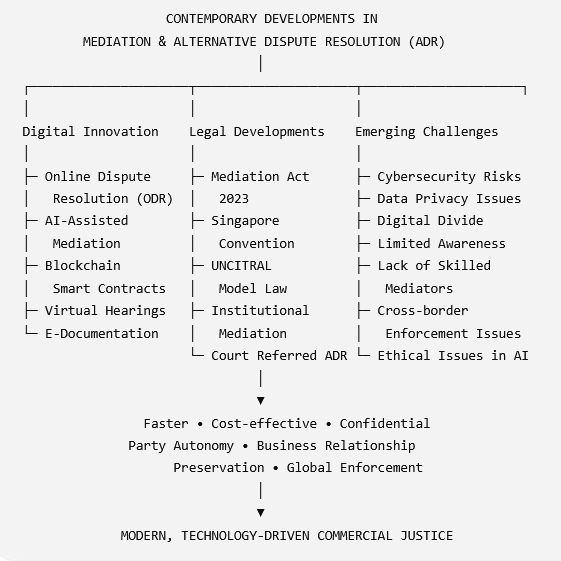
Figure: Emerging Trends in Commercial Mediation and ADR
One of the foremost concerns relates to cybersecurity and data protection. Commercial mediation frequently involves confidential business information, financial records, intellectual property, trade secrets, and sensitive contractual documents. Unauthorized access, cyberattacks, data breaches, or system failures may compromise confidentiality and undermine trust in digital dispute resolution platforms. Consequently, robust cybersecurity frameworks, encryption technologies, secure authentication mechanisms, and compliance with data protection laws have become essential components of modern ODR systems. Another important challenge concerns the legal recognition and enforceability of electronically executed settlement agreements across different jurisdictions. Variations in national legislation regarding electronic signatures, digital evidence, online mediation procedures, and cross-border enforcement continue to create legal uncertainty for international commercial disputes. Capacity constraints also present significant obstacles. Many businesses, particularly small and medium-sized enterprises (SMEs), remain unfamiliar with mediation processes and digital dispute resolution technologies. Limited digital infrastructure, inadequate internet connectivity in certain regions, shortage of trained mediators, lack of technological expertise, and insufficient institutional support may restrict access to efficient ADR mechanisms. Ethical issues surrounding AI-assisted mediation have also attracted increasing attention. Algorithmic bias, lack of transparency in automated decision-support systems, accountability for AI-generated recommendations, and the preservation of mediator neutrality require careful regulatory oversight to ensure that technology complements rather than compromises fairness and procedural justice. Furthermore, cultural diversity, language barriers, differing legal traditions, and varying negotiation styles continue to influence mediation outcomes in cross-border commercial disputes, necessitating specialized mediator training and culturally sensitive dispute resolution approaches. Looking toward the future, mediation and ADR are expected to become increasingly technology-driven, integrated, and globally harmonized. Governments are likely to strengthen legislative frameworks supporting digital mediation, electronic settlement agreements, and cross-border enforcement through greater adoption of international standards such as the Singapore Convention on Mediation. Artificial intelligence will continue to evolve as an assistive tool for legal analytics, predictive dispute management, multilingual communication, and automated administrative processes while remaining subject to ethical safeguards and human oversight. Blockchain-enabled smart contracts, digital identity verification, secure cloud-based evidence repositories, and interoperable international mediation platforms are expected to improve transparency, trust, and procedural efficiency. Educational institutions, professional organizations, and mediation centers will increasingly focus on capacity building, accreditation, interdisciplinary training, and continuous professional development for mediators. Governments and judicial institutions are also expected to expand public awareness campaigns encouraging businesses to adopt mediation before resorting to litigation. Ultimately, the future of commercial dispute resolution lies in combining technological innovation with fundamental legal principles such as party autonomy, confidentiality, neutrality, procedural fairness, and enforceability. By embracing digital transformation while preserving the collaborative nature of mediation, modern ADR systems can provide businesses with efficient, accessible, and sustainable mechanisms for resolving commercial disputes, thereby strengthening investor confidence, promoting ease of doing business, reducing judicial backlog, and contributing to the development of a resilient global commercial justice system.
Conclusion#
Mediation and Alternative Dispute Resolution (ADR) have emerged as indispensable components of modern commercial justice systems, offering businesses efficient, flexible, confidential, and cost-effective alternatives to conventional litigation. The increasing complexity of commercial transactions, globalization of trade, rapid technological advancement, cross-border investments, and the expansion of digital commerce have transformed the nature of commercial disputes, making traditional court-based adjudication insufficient to meet the evolving needs of the business community. Litigation often involves lengthy procedures, substantial financial costs, procedural rigidity, and adversarial outcomes that may permanently damage valuable commercial relationships. In contrast, mediation emphasizes cooperation, dialogue, mutual understanding, and consensual problem-solving, enabling parties to preserve long-term business partnerships while achieving legally enforceable and commercially practical settlements. International legal developments, particularly the UNCITRAL Model Law on International Commercial Mediation and the Singapore Convention on Mediation, have significantly strengthened the legal status and global recognition of mediation by establishing internationally accepted standards for the conduct and enforcement of mediated settlement agreements. These developments have increased business confidence in mediation as an effective mechanism for resolving complex domestic and international commercial disputes. India has similarly undertaken substantial legal reforms through the Arbitration and Conciliation Act, 1996, the Commercial Courts Act, 2015, judicial initiatives encouraging court-referred mediation, and most notably the Mediation Act, 2023, which provides a comprehensive statutory framework governing mediation across civil and commercial disputes. The enactment of the Mediation Act represents a transformative milestone in India's legal landscape by promoting pre-litigation mediation, institutional mediation, online mediation, confidentiality, party autonomy, and enforceability of settlement agreements. Simultaneously, technological innovations including Online Dispute Resolution (ODR), artificial intelligence-assisted case management, blockchain-based contract verification, virtual hearings, and digital evidence management systems are fundamentally reshaping the administration of commercial justice. These technologies have improved accessibility, reduced costs, accelerated dispute resolution, and enabled businesses located in different jurisdictions to resolve disputes efficiently without geographical limitations. Nevertheless, the modernization of commercial mediation also presents several legal, ethical, and practical challenges. Cybersecurity risks, data privacy concerns, inconsistent legal recognition of digital settlement agreements, limited public awareness, shortage of trained mediators, inadequate institutional infrastructure, algorithmic bias in AI systems, and jurisdictional differences in mediation laws continue to affect the effectiveness of ADR mechanisms. Small and medium-sized enterprises often face additional barriers due to limited financial resources, lack of technological capacity, and insufficient familiarity with mediation processes. Addressing these challenges requires coordinated efforts by governments, judicial institutions, professional organizations, educational institutions, and international organizations to strengthen legislative frameworks, enhance mediator training, develop secure digital platforms, and harmonize international standards governing commercial mediation. Future reforms should focus on expanding institutional mediation centers, improving technological infrastructure, encouraging international cooperation, promoting ethical AI governance, strengthening cybersecurity protections, and increasing business awareness regarding the advantages of consensual dispute resolution. Universities and legal education institutions should incorporate mediation, negotiation, and dispute resolution skills into professional training programs to develop a highly qualified generation of mediators capable of addressing increasingly sophisticated commercial conflicts. Businesses should also integrate ADR clauses into commercial contracts and adopt proactive dispute prevention strategies to reduce litigation risks and preserve commercial relationships. Ultimately, mediation is no longer merely an alternative to litigation but has become an essential component of an effective, accessible, and sustainable commercial justice system. By combining legal certainty with flexibility, confidentiality, technological innovation, and collaborative problem-solving, mediation contributes significantly to improving the ease of doing business, reducing judicial backlog, strengthening investor confidence, promoting economic growth, and fostering long-term commercial stability. As global commerce continues to evolve in an increasingly digital and interconnected environment, mediation and ADR will remain central to the future of commercial dispute resolution, ensuring that businesses have access to efficient, fair, and internationally recognized mechanisms for resolving disputes while supporting sustainable economic development and the rule of law.
Works Cited#
- Boulle, L. (2021). Mediation: Principles, Process, Practice (4th ed.). Bloomsbury Publishing.
- Government of India. (2023). The Mediation Act, 2023. Ministry of Law and Justice.
- Government of India. (1996). The Arbitration and Conciliation Act, 1996. Ministry of Law and Justice.
- Government of India. (2015). The Commercial Courts Act, 2015. Ministry of Law and Justice.
- International Bar Association. (2021). IBA Guidelines on Mediation. International Bar Association.
- International Chamber of Commerce. (2024). ICC Mediation Rules. ICC Publishing.
- Menkel-Meadow, C. (2018). Negotiation, Mediation and Other Processes. Aspen Publishers.
- Nolan-Haley, J. M. (2020). Alternative Dispute Resolution in a Nutshell (6th ed.). West Academic Publishing.
- Susskind, R. (2019). Online Courts and the Future of Justice. Oxford University Press.
- United Nations. (2019). United Nations Convention on International Settlement Agreements Resulting from Mediation (Singapore Convention on Mediation). United Nations.
- United Nations Commission on International Trade Law. (2018). UNCITRAL Model Law on International Commercial Mediation and International Settlement Agreements Resulting from Mediation. United Nations.
- United Nations Commission on International Trade Law. (2021). UNCITRAL Notes on Mediation. United Nations.
- Born, G. B. (2021). International Commercial Arbitration (3rd ed.). Kluwer Law International.
- Moore, C. W. (2014). The Mediation Process: Practical Strategies for Resolving Conflict (4th ed.). Jossey-Bass.
- Alexander, N. (Ed.). (2019). Global Trends in Mediation (3rd ed.). Kluwer Law International.
- Strong, S. I. (2016). International Commercial Mediation: A Guide for Business Lawyers and Mediators. Oxford University Press.
- Sourdin, T. (2021). Alternative Dispute Resolution (6th ed.). Thomson Reuters.
- Eisenberg, T., & Miller, G. P. (2019). The flight from arbitration: An empirical study of ex ante arbitration clauses in public companies' contracts. DePaul Law Review, 56(2), 335–374.
- Singapore International Mediation Centre. (2024). SIMC Mediation Rules. Singapore International Mediation Centre.
- World Bank. (2023). Business Ready Report: Efficient Commercial Dispute Resolution. World Bank.