Abstract
Rural and tribal communities across many regions continue to rely substantially on locally available medicinal plants for primary healthcare, guided by ethnobotanical knowledge transmitted through generations of traditional and folk-medicine practitioners. This ethnopharmacological survey documents plant species, preparation methods, and reported therapeutic indications used within selected rural community healthcare practices, cross-referencing findings against classical Ayurvedic and Unani texts to assess correspondence with codified traditional-medicine systems. The study also evaluates conservation status and sustainable harvesting practices for the most frequently cited species, given increasing pressure on wild medicinal-plant populations from commercial demand. Findings contribute to the growing body of ethnopharmacological literature supporting bioprospecting, community-based conservation, and the scientific validation of traditional remedies as candidates for further pharmacological investigation.
- Ethnopharmacology
- Medicinal Plants
- Traditional Knowledge
- Rural Healthcare
- Ayurveda
- Bioprospecting
- Conservation
- Folk Medicine
Introduction#
Traditional knowledge systems and indigenous practices have played an important role in shaping human societies for centuries. Before the development of modern science and technology, communities depended on their local knowledge, experiences, beliefs, observations, and practices to manage natural resources, maintain health, produce food, preserve culture, and organize social life. This knowledge was passed from one generation to another through oral traditions, rituals, customs, stories, songs, festivals, family practices, and community participation.
Traditional knowledge refers to the collective wisdom developed by communities through long-term interaction with their natural and social environment. It includes knowledge related to agriculture, forest management, water conservation, medicinal plants, animal care, climate prediction, food preservation, housing, crafts, weaving, fishing, conflict resolution, community governance, and cultural expression. Such knowledge is deeply connected with local ecology, community identity, and sustainable living.
Indigenous practices are the practical expressions of traditional knowledge. They include farming methods, seed preservation, herbal healing, rainwater harvesting, sacred groves, traditional architecture, folk medicine, organic manure use, community festivals, oral storytelling, local art forms, and rituals associated with nature. These practices are not merely cultural activities; they often contain deep ecological and social wisdom.
In the present era, sustainable community development has become a major global concern. Rapid industrialization, urbanization, deforestation, pollution, climate change, biodiversity loss, and excessive consumption have created serious environmental and social challenges. Modern development models often focus on economic growth but may ignore local culture, ecological balance, and community participation. In this context, traditional knowledge systems can provide valuable guidance for sustainable development.
Traditional knowledge promotes sustainable community development because it is usually based on harmony with nature. Many indigenous communities use natural resources carefully and avoid unnecessary exploitation. Their practices often emphasize conservation, reuse, biodiversity protection, soil fertility, water preservation, and collective responsibility. For example, traditional farming systems use local seeds, organic manure, mixed cropping, and seasonal knowledge. These methods support food security and ecological balance.
Water conservation is another area where traditional knowledge is important. Many communities have developed local systems for harvesting rainwater, managing ponds, protecting springs, and distributing water fairly. Such practices are especially useful in areas facing drought, water scarcity, and climate variability. Similarly, traditional forest management practices protect biodiversity and maintain the relationship between community life and natural resources.
Traditional medicine is also an important part of indigenous knowledge. Many communities use medicinal plants, herbs, oils, and natural healing methods for common illnesses. Although modern medicine is essential, traditional healing knowledge can support primary healthcare, especially in rural and remote areas. However, such knowledge should be documented carefully and used responsibly with proper scientific understanding.
Cultural preservation is another major dimension of traditional knowledge systems. Culture gives identity, continuity, dignity, and meaning to community life. Folk songs, dances, festivals, local languages, oral histories, rituals, crafts, food traditions, dress patterns, and community customs preserve the memory and values of a society. Indigenous practices keep communities connected with their ancestors, land, and collective identity.
In the modern age, many traditional knowledge systems are facing decline. Globalization, migration, urbanization, formal education systems, market-based lifestyles, and loss of natural resources have weakened the transmission of indigenous knowledge. Younger generations may consider traditional practices outdated and may move away from local languages, crafts, food habits, and cultural customs. This creates a risk of cultural loss and identity crisis.
Therefore, there is a need to document, protect, and promote traditional knowledge systems. Educational institutions, government agencies, researchers, NGOs, and community leaders should work together to preserve indigenous wisdom. Traditional knowledge should not be treated as backward or unscientific; rather, it should be understood, respected, and integrated with modern knowledge wherever suitable.
The present study is significant because it examines the relationship between local wisdom, sustainability, and cultural continuity. It highlights that development should not destroy cultural identity or ecological balance. Instead, development should be inclusive, community-based, and respectful of traditional practices. Thus, traditional knowledge systems and indigenous practices are valuable resources for sustainable community development and cultural preservation. They provide practical solutions for environmental management, livelihood security, social cooperation, and cultural identity. Recognizing and protecting this knowledge is essential for building a sustainable, inclusive, and culturally rich society.
Traditional Knowledge Systems and Sustainable Community Development#
Traditional knowledge systems play an important role in sustainable community development because they are based on long-term experience, local needs, and close interaction with nature. Communities have developed these knowledge systems over many generations by observing land, water, forests, animals, climate, seasons, crops, and social life. This knowledge is practical, community-based, and connected with everyday survival. Sustainable community development means improving the quality of life of people without damaging natural resources or destroying future opportunities. Traditional knowledge supports this idea because it usually promotes balance between human needs and environmental protection. Indigenous communities often use resources carefully because their livelihood depends directly on land, forests, rivers, soil, animals, and biodiversity. Traditional farming practices are a good example of sustainable development. Many communities use local seeds, mixed cropping, crop rotation, organic manure, natural pest control, and seasonal knowledge. These methods protect soil fertility, reduce dependence on chemicals, and support food security. Traditional agriculture is often climate-friendly and suitable for local environmental conditions. Traditional water-management systems also support sustainable development. Communities have developed ponds, wells, stepwells, rainwater harvesting structures, canals, and local irrigation systems according to geographical conditions. These systems help conserve water, recharge groundwater, and distribute water fairly. In areas facing water scarcity, such local practices can provide useful solutions. Traditional knowledge also helps in forest and biodiversity conservation. Many indigenous communities protect sacred groves, community forests, medicinal plants, and wildlife through customs, beliefs, and rules. These practices are not only religious or cultural but also ecological. They help maintain biodiversity and prevent overuse of natural resources.
Community participation is an important feature of traditional knowledge systems. Decisions related to land, water, farming, festivals, resource sharing, and conflict resolution are often made collectively. This strengthens social cooperation and responsibility. Sustainable development becomes more effective when local people are involved in planning and implementation.
Traditional knowledge also supports sustainable livelihoods. Handicrafts, weaving, pottery, herbal medicine, food processing, animal husbandry, fishing, forest produce collection, and traditional architecture provide income and employment to local communities. These livelihoods use local resources and skills, reducing dependence on external markets.
However, traditional knowledge should not be romanticized without understanding its limitations. Some practices may need improvement, scientific validation, or adaptation to present conditions. The best approach is to combine useful traditional knowledge with modern science and technology.
Thus, traditional knowledge systems are valuable for sustainable community development. They promote ecological balance, local self-reliance, community participation, livelihood security, and responsible use of natural resources.
Indigenous Practices and Environmental Conservation#
Indigenous practices have a strong relationship with environmental conservation. Many indigenous communities consider nature as a living system and treat land, forests, rivers, animals, mountains, and plants with respect. Their practices are often guided by the belief that human beings are part of nature, not separate from it. This worldview encourages careful use of natural resources and protection of the environment.
One important indigenous practice is the protection of sacred natural sites. Sacred groves, sacred forests, rivers, ponds, mountains, and trees are protected by community customs and religious beliefs. Cutting trees, hunting animals, or polluting such places is often prohibited. These practices help conserve biodiversity and protect local ecosystems.
Traditional agricultural practices also help conserve the environment. Indigenous farmers often use organic manure, compost, mixed cropping, seed preservation, and natural pest control. These methods reduce chemical pollution and maintain soil health. Traditional seed varieties are often more resistant to local climate conditions, pests, and drought. Preserving these seeds helps maintain agricultural biodiversity.
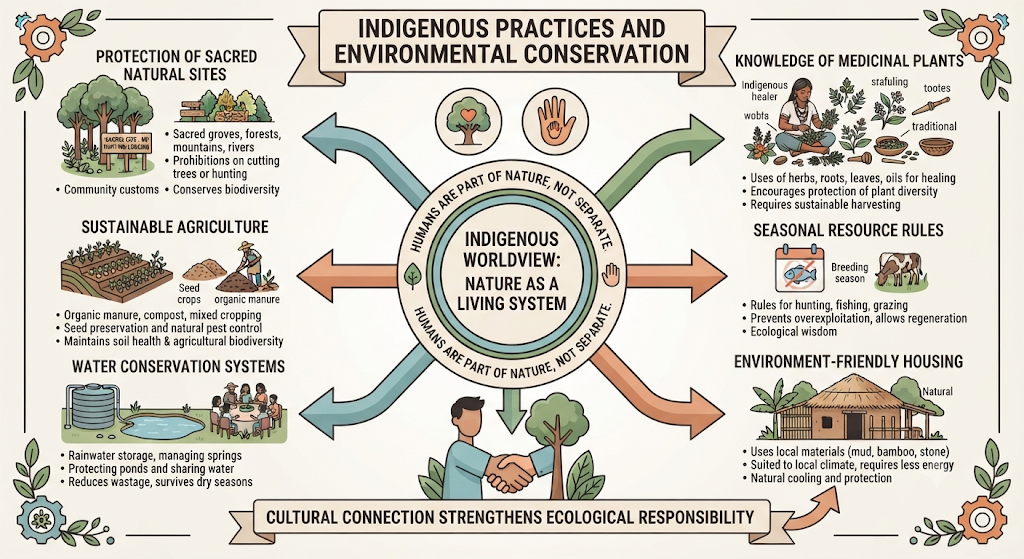
Indigenous water conservation practices are also highly valuable. Many communities have developed local systems for storing rainwater, managing springs, protecting ponds, and sharing irrigation water. These systems are based on local geography and climate. They reduce water wastage and help communities survive during dry seasons.
Traditional knowledge of medicinal plants also supports environmental conservation. Indigenous communities often know the uses of herbs, roots, leaves, flowers, and oils for healing. This knowledge encourages the protection of plant diversity. However, over-commercialization of medicinal plants can create risks, so sustainable harvesting is necessary.
Indigenous housing practices are also environment-friendly. Traditional houses are often built using local materials such as mud, bamboo, wood, stone, grass, and clay. These houses are suited to local climate and require less energy. They provide natural cooling, ventilation, and protection from weather. Such architecture can inspire sustainable housing today.
Indigenous communities also follow seasonal rules for hunting, fishing, grazing, and forest use. These rules prevent overexploitation and allow natural regeneration. For example, some communities avoid fishing during breeding seasons or restrict forest collection during certain months. Such practices show ecological wisdom.
Environmental conservation through indigenous practices is not only about resource protection; it is also about cultural values. When people feel emotionally and spiritually connected with nature, they are more likely to protect it. This connection strengthens ecological responsibility.
However, modern pressures such as deforestation, mining, industrialization, tourism, land acquisition, and market-based exploitation threaten indigenous conservation practices. Therefore, governments and development agencies should recognize and protect indigenous environmental knowledge.
Traditional Knowledge and Cultural Preservation#
Traditional knowledge systems are deeply connected with cultural preservation. Culture includes language, beliefs, customs, festivals, rituals, food habits, dress, music, dance, oral stories, crafts, architecture, community values, and social practices. Traditional knowledge keeps these cultural elements alive by passing them from one generation to another.
Cultural preservation is important because it gives people identity, belongingness, dignity, and continuity. A community without cultural memory may lose its connection with its history, land, ancestors, and collective values. Traditional knowledge protects this memory through oral traditions, folk songs, legends, proverbs, rituals, and everyday practices.
Language is one of the most important carriers of traditional knowledge. Many indigenous practices, plant names, healing methods, farming techniques, songs, and stories exist in local languages. When a language disappears, much traditional knowledge also disappears. Therefore, protecting local languages is essential for cultural preservation.
Traditional festivals and rituals also preserve culture. Many festivals are connected with agriculture, seasons, harvest, rain, forests, rivers, animals, and community life. These celebrations teach younger generations about nature, gratitude, cooperation, and social responsibility. They also strengthen community unity and cultural identity.
Handicrafts and traditional arts are another important part of cultural preservation. Weaving, pottery, woodwork, metalwork, painting, embroidery, basket-making, jewellery, folk instruments, and traditional clothing reflect local creativity and skill. These crafts are not merely economic activities; they represent history, aesthetics, identity, and community knowledge.
Traditional food practices also preserve cultural identity. Local foods are often based on seasonal crops, medicinal herbs, climate, occupation, and community customs. Traditional diets may be healthy, sustainable, and connected with local agriculture. Fast food culture and market-based consumption may weaken such food traditions.
Traditional healing systems also form part of cultural preservation. Knowledge of herbs, oils, massage, bone-setting, childbirth practices, and preventive health traditions has been preserved within families and communities. Although such knowledge should be used carefully, it remains an important cultural resource. Modernization and globalization have created challenges for cultural preservation. Younger generations may prefer modern lifestyles and may not learn local songs, crafts, languages, or rituals. Migration and urbanization also weaken community-based transmission of knowledge. Many traditional practices are disappearing because elders are not able to pass them on. Documentation is necessary to preserve traditional knowledge. Oral histories, songs, rituals, farming methods, medicinal practices, and crafts should be recorded with community consent. Schools and universities can include local cultural knowledge in education. Community museums, cultural festivals, craft centres, and digital archives can also help. Thus, traditional knowledge plays a vital role in cultural preservation. It protects identity, language, history, values, skills, and community memory. Cultural preservation is necessary for maintaining diversity and strengthening social continuity.
Challenges and Measures for Protecting Traditional Knowledge Systems#
Traditional knowledge systems and indigenous practices are facing many challenges in the modern world. One major challenge is globalization. Global markets, modern consumer culture, mass media, and uniform lifestyles often reduce interest in local traditions. Young people may consider traditional practices old-fashioned and may prefer modern products, languages, and lifestyles.
Migration and urbanization also weaken traditional knowledge. When people move from villages to cities, they become separated from land, forests, elders, festivals, and community practices. Children growing up in urban areas may not learn local crafts, farming methods, folk songs, traditional food habits, or indigenous languages.
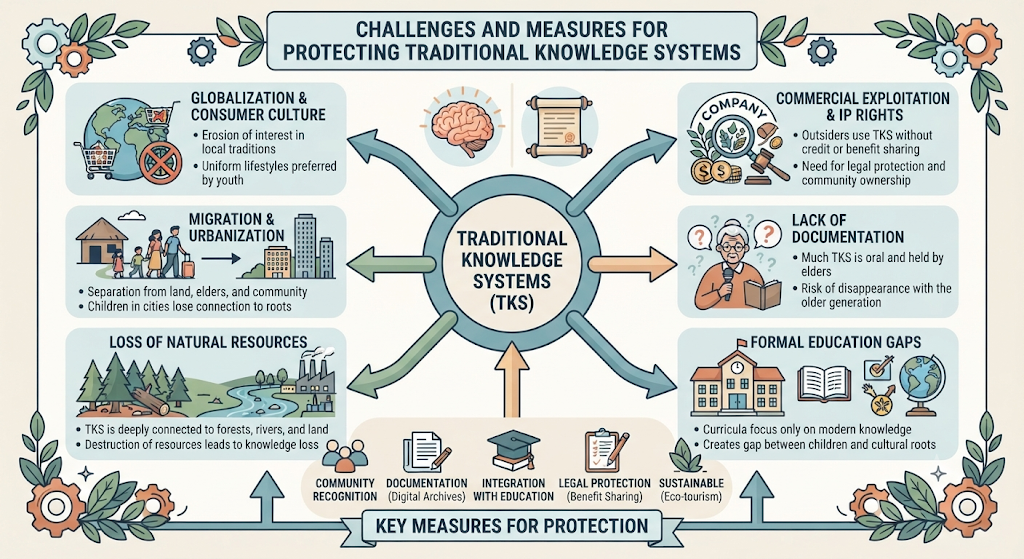 Loss of natural resources is another serious problem. Traditional knowledge is closely connected with forests, rivers, land, plants, animals, and local climate. When forests are destroyed, rivers are polluted, or land is taken for development projects, the knowledge linked with these resources also declines. Indigenous communities may lose both livelihood and culture.
Commercial exploitation is another challenge. Sometimes companies or outsiders use traditional knowledge of medicinal plants, seeds, crafts, or designs without giving credit or benefit to the original communities. This is a form of knowledge exploitation. Protection of intellectual property rights and community ownership is therefore necessary.
Lack of documentation also threatens traditional knowledge. Much indigenous knowledge exists orally and is held by elders. If it is not recorded, it may disappear with the older generation. However, documentation should be done respectfully and with the consent of the community.
Formal education systems may also ignore traditional knowledge. Many school curricula focus only on modern knowledge and do not include local history, ecology, language, crafts, or indigenous practices. This creates a gap between children and their cultural roots. To protect traditional knowledge systems, several measures are needed. First, local communities should be recognized as knowledge holders. Their wisdom should be respected, not treated as backward or unscientific. Development programmes should involve community participation. Second, traditional knowledge should be documented through books, audio recordings, videos, museums, digital archives, and community records. Elders, artisans, healers, farmers, and cultural performers should be involved in this process. Third, traditional knowledge should be integrated with modern education. Schools and universities can include local culture, environmental knowledge, traditional agriculture, crafts, oral histories, and indigenous practices in learning activities. Fourth, legal protection is necessary. Communities should have rights over their traditional knowledge, biological resources, cultural symbols, and artistic designs. Benefit-sharing mechanisms should be developed when traditional knowledge is used commercially. Fifth, sustainable livelihoods based on traditional knowledge should be promoted. Handicrafts, eco-tourism, herbal products, organic farming, traditional food, and cultural festivals can provide income while preserving culture. However, commercialization should not distort or exploit cultural practices.
Conclusion#
The study concludes that traditional knowledge systems and indigenous practices play a significant role in promoting sustainable community development and cultural preservation. Traditional knowledge is based on the long experience of communities and reflects their close relationship with nature, society, and culture. It supports sustainable development through eco-friendly agriculture, water conservation, forest protection, biodiversity preservation, traditional medicine, local crafts, and community-based resource management. Indigenous practices encourage careful use of natural resources and promote harmony between human beings and the environment. They also strengthen community participation, local self-reliance, social cooperation, and livelihood security. At the same time, traditional knowledge helps preserve cultural identity through language, oral traditions, festivals, rituals, folk arts, food habits, healing practices, and community customs. However, globalization, migration, urbanization, modernization, loss of natural resources, and lack of documentation are major threats to traditional knowledge systems. Therefore, it is necessary to document, protect, and promote indigenous knowledge with the active participation of local communities. Traditional knowledge should be respected, integrated with modern education, and protected through suitable policies and legal safeguards. The traditional knowledge systems are not only part of cultural heritage but also valuable tools for sustainable development, ecological balance, and social harmony.
Bibliography
Works Cited#
- Agrawal, Arun. “Dismantling the Divide between Indigenous and Scientific Knowledge.” Development and Change, vol. 26, no. 3, 1995, pp. 413–439.
- Berkes, Fikret. Sacred Ecology. 4th ed., Routledge, 2018.
- Chambers, Robert. Rural Development: Putting the Last First. Routledge, 1983.
- Gadgil, Madhav, Fikret Berkes, and Carl Folke. “Indigenous Knowledge for Biodiversity Conservation.” Ambio, vol. 22, no. 2–3, 1993, pp. 151–156.
- Grenier, Louise. Working with Indigenous Knowledge: A Guide for Researchers. International Development Research Centre, 1998.
- Gupta, Anil K. Grassroots Innovation: Minds on the Margin Are Not Marginal Minds. Penguin Books India, 2016.
- Haverkort, Bertus, Johan van der Kamp, and Ann Waters-Bayer, editors. Joining Farmers’ Experiments: Experiences in Participatory Technology Development. Intermediate Technology Publications, 1991.
- Howes, Michael, and Robert Chambers. “Indigenous Technical Knowledge: Analysis, Implications and Issues.” IDS Bulletin, vol. 10, no. 2, 1979, pp. 5–11.
- International Labour Organization. Indigenous Peoples and Climate Change: From Victims to Change Agents through Decent Work. ILO, 2017.
- Maffi, Luisa, editor. On Biocultural Diversity: Linking Language, Knowledge, and the Environment. Smithsonian Institution Press, 2001.
- Nakashima, Douglas, and Marie Roué. “Indigenous Knowledge, Peoples and Sustainable Practice.” Social and Economic Dimensions of Global Environmental Change, edited by Peter Timmerman, Wiley, 2002, pp. 314–324.
- Posey, Darrell A., editor. Cultural and Spiritual Values of Biodiversity. Intermediate Technology Publications, 1999.
- Shiva, Vandana. Staying Alive: Women, Ecology and Development. Kali for Women, 1988.
- Sillitoe, Paul. “The Development of Indigenous Knowledge: A New Applied Anthropology.” Current Anthropology, vol. 39, no. 2, 1998, pp. 223–252.
- Thrupp, Lori Ann. “Legitimizing Local Knowledge: From Displacement to Empowerment for Third World People.” Agriculture and Human Values, vol. 6, no. 3, 1989, pp. 13–24.
- UNESCO. Convention for the Safeguarding of the Intangible Cultural Heritage. UNESCO, 2003.
- UNESCO. Local and Indigenous Knowledge Systems. UNESCO, 2017.
- United Nations. United Nations Declaration on the Rights of Indigenous Peoples. United Nations, 2007.
- Warren, D. Michael. “Using Indigenous Knowledge in Agricultural Development.” World Bank Discussion Paper, no. 127, 1991.
- World Commission on Environment and Development. Our Common Future. Oxford University Press, 1987.